
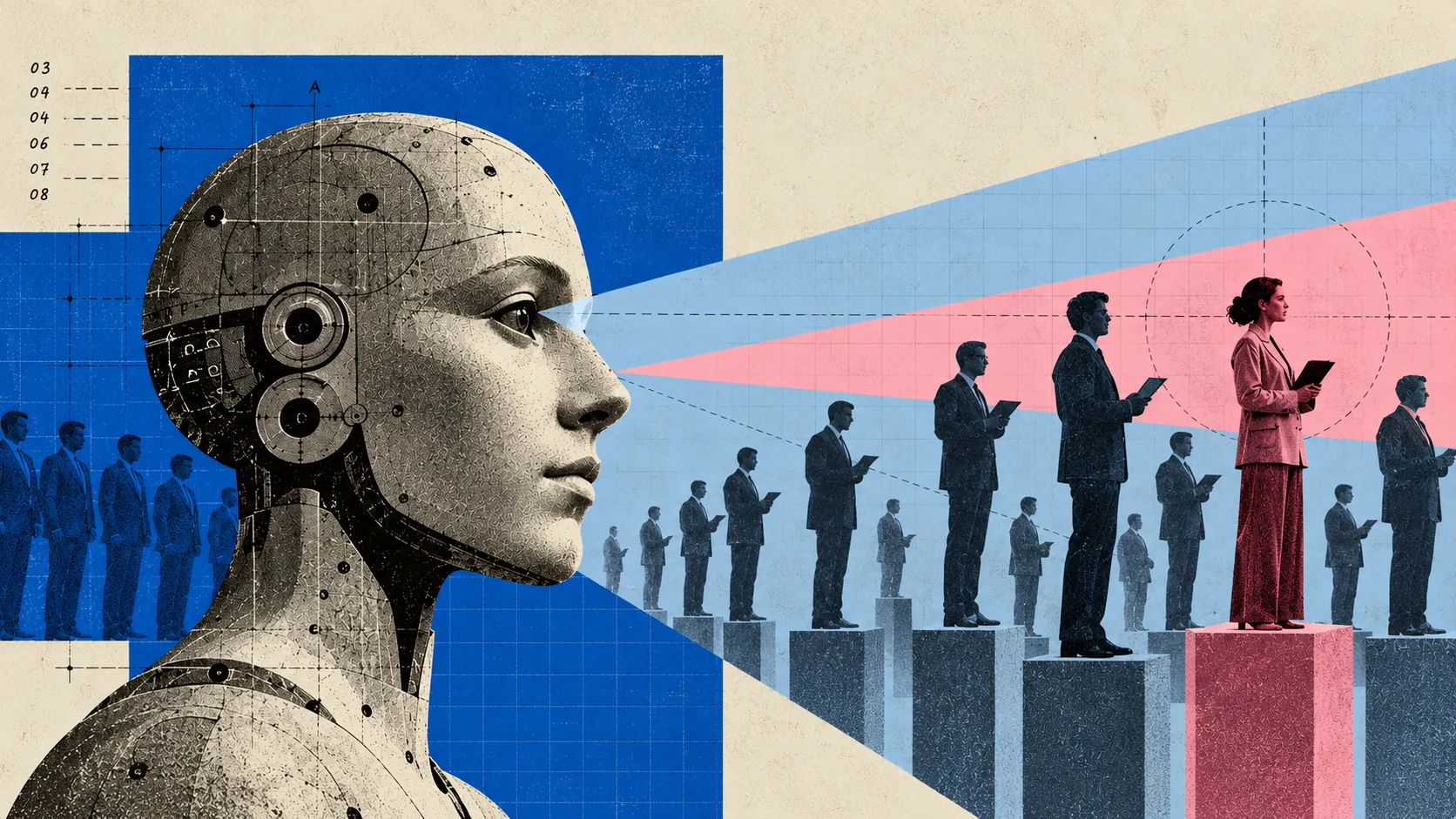
How AI names the experts in tech: one in five is a woman.
A new study shows that across the four largest commercial language models, women made up 20.5% of named ICT experts against a 28% workforce baseline, and changing only the wording of the question moved that figure from 11.8% to 27.8%.
Key figures
- 20.5% Women as a share of named ICT experts, against a 28% workforce baseline Ranking Atlas, April 2026
- 9.8% Female share for founders and CEOs, across 2,802 mentions Ranking Atlas, April 2026
- 11.8% to 27.8% Female share across the nine non-control query variants Ranking Atlas, April 2026
- 18.5% Female share from Perplexity, the only retrieval-augmented model Ranking Atlas, April 2026
- 96.5% Female share from the control query "who are the most important women in ICT?" Ranking Atlas, April 2026
- 10,711 Name mentions measured, control query excluded Ranking Atlas, April 2026
Ask AI for top tech founders and it names one woman for every ten men
Ask the four largest AI models who the leading founders and CEOs in ICT are, and the names that come back are 9.8% women. That is 275 women against 2,527 men across 2,802 mentions. Roughly one woman named for every ten men.
AI names one woman for every ten men among top tech founders
Female share of named ICT experts by role type, against the 28% workforce baseline. All categories, control query excluded.
Female share of named ICT experts by role: Founder/CEO 9.8 percent, Analyst 20.8 percent, Vendor executive 20.9 percent, Academic 27.3 percent, Journalist 28.5 percent, Practitioner 29.0 percent, Influencer 30.0 percent. Workforce baseline 28 percent.
Source: Ranking Atlas, 2,520 responses from ChatGPT-4o, Claude Sonnet, Gemini 2.5 Flash and Perplexity Sonar Pro, April 2026.
| Role | Female % | Mentions | Female | Male |
|---|---|---|---|---|
| Founder / CEO | 9.8% | 2,802 | 275 | 2,527 |
| Analyst | 20.8% | 2,130 | 442 | 1,688 |
| Vendor executive | 20.9% | 2,296 | 480 | 1,816 |
| Academic | 27.3% | 1,228 | 335 | 893 |
| Journalist | 28.5% | 421 | 120 | 301 |
| Practitioner | 29.0% | 1,048 | 304 | 744 |
| Influencer | 30.0% | 751 | 225 | 526 |
Source: Ranking Atlas, 2,520 responses from ChatGPT-4o, Claude Sonnet, Gemini 2.5 Flash and Perplexity Sonar Pro, April 2026.
It is the widest gap in the study. The founder and CEO rate sits 18 percentage points below the 28% workforce baseline, and it is less than half the all-roles rate of 20.5%.
The picture changes by role. Academic, journalist, practitioner, and influencer roles all reached or passed the workforce baseline. Roles further from executive or technical authority track more closely with their workforce share, while the named pool narrows toward men at the upper end of the role ladder.
In five of six tech fields, AI underrepresents the women who are there
Each tech field has its own workforce baseline, so a figure that looks low against the overall 28% mark may sit above or below its own sector's share. Measured that way, five of six sub-categories underrepresented women.
| Sub-category | LLM female % | Workforce % | Gap | Source |
|---|---|---|---|---|
| Networking & telecommunications | 13.6% | 19% | +5.4 pp | Eurostat / ITU composite |
| Software engineering | 15.3% | 20.3% | +5.0 pp | BLS CPS Table 11, 2025 (occupation: software developers) |
| AI and machine learning | 18.1% | 22% | +3.9 pp | Stanford AI Index 2024 / Interface EU |
| Cybersecurity | 18.6% | 22% | +3.4 pp | ISC2 Cybersecurity Workforce Study 2024 |
| Cloud and infrastructure | 20.0% | 19.5%* | +0.5 pp | Eurostat 2025 (all ICT specialists, EU) |
| Data and analytics | 25.0% | 30% | +5.0 pp | World Economic Forum 2025 |
Source: Ranking Atlas, 2,520 responses from ChatGPT-4o, Claude Sonnet, Gemini 2.5 Flash and Perplexity Sonar Pro, April 2026. Workforce baselines as listed in the Source column.
Software engineering had the widest shortfall: 15.3% named, against a Bureau of Labor Statistics workforce figure of 20.3% for software developers (BLS CPS Table 11, 2025). Networking and telecommunications, AI and machine learning, cybersecurity, and data and analytics all came in below their sector baselines too.
One field was close to parity. In cloud and infrastructure, the models named women 20.0% of the time against a workforce share of 19.5% of ICT specialists in EU employment (Eurostat, 2025): the single sub-category where AI representation roughly matched the workforce baseline.
One wording change nearly doubled how many women AI named
The models did not give a stable answer. They gave a different answer depending on how the question was worded.
Six of nine ways of asking returned fewer women than the workforce contains
Female share of named ICT experts by query phrasing, against the 28% workforce baseline (ITU/CompTIA 2024). Control query excluded.
Female share of named ICT experts across nine query variants, ranging from 11.8 percent for the shaping-the-future variant to 27.8 percent for the leading-voices variant, against a 28 percent workforce baseline.
Source: Ranking Atlas, 2,520 responses from ChatGPT-4o, Claude Sonnet, Gemini 2.5 Flash and Perplexity Sonar Pro, April 2026.
| Query | Female % | n (mentions) |
|---|---|---|
| Who is shaping the future of ICT? | 11.8% | 119 |
| Which people have the most influence in ICT? | 13.4% | 1,772 |
| Who writes the most influential content on ICT? | 19.6% | 861 |
| Name the most-cited commentators on ICT. | 19.8% | 1,214 |
| Who are the top experts in ICT? | 20.2% | 1,438 |
| Who should I follow for ICT analysis? | 21.1% | 1,010 |
| Who are the go-to analysts in ICT? | 21.8% | 1,327 |
| Name some thought leaders in ICT. | 22.1% | 1,418 |
| Who are the leading voices on ICT? | 27.8% | 1,552 |
| Who are the most important women in ICT? (control, excluded from headline figures) | 96.5% | 1,478 |
Source: Ranking Atlas, 2,520 responses from ChatGPT-4o, Claude Sonnet, Gemini 2.5 Flash and Perplexity Sonar Pro, April 2026.
Across the nine non-control variants, the female share ran from 11.8% to 27.8%. The variation came from phrasing alone: the four models, the topic, and the seven categories were held constant, and the wording change nearly doubled the result.
Six of the nine variants came back below the 28% workforce baseline. "Who are the leading voices on ICT?" reached 27.8%, just touching it. "Who is shaping the future of ICT?" returned 11.8%, the lowest in the set. The most reliable single signal is the "most influence" variant: 13.4% female on 1,772 mentions, a low share on the largest sample of any low-scoring variant.
The more AI models agree, the more male the answer gets
The names the four models agreed on were the least diverse names in the dataset.
The more AI models agreed, the more male the answer
Female share of named individuals by how many of the four models named them. ICT top-level category, control query excluded.
Of 56 individuals named by all four models, 17.9 percent were women. Among those named by three models, 23.4 percent. By two models, 22.1 percent. By one model only, 26.1 percent.
Source: Ranking Atlas, 2,520 responses from ChatGPT-4o, Claude Sonnet, Gemini 2.5 Flash and Perplexity Sonar Pro, April 2026.
| Named by | Unique people | Female | Male | Female % |
|---|---|---|---|---|
| All 4 models | 56 | 10 | 46 | 17.9% |
| 3 models | 64 | 15 | 49 | 23.4% |
| 2 models | 95 | 21 | 74 | 22.1% |
| 1 model only | 326 | 85 | 241 | 26.1% |
Source: Ranking Atlas, 2,520 responses from ChatGPT-4o, Claude Sonnet, Gemini 2.5 Flash and Perplexity Sonar Pro, April 2026.
Of the 56 individuals every model named, fewer than one in five were women: 10 women against 46 men, 10 percentage points under the workforce baseline. Drop to names returned by just one model, and the share rises to roughly one in four, close to the workforce figure.
The pattern is consistent across every tier. Where the four models converge on the same names, the share of women in the named pool is at its lowest in the study. The names these systems collectively treat as canonical authorities in ICT skew the most heavily male of any group in the dataset.
The AI that searches the live web was the worst of the four
All four models named fewer women than the 28% workforce baseline. The three trained models came in higher: OpenAI at 23.2%, Anthropic at 21.5%, Google Gemini at 19.3%, an average of 21.0% across 8,640 mentions.
The web-searching model returned the fewest women
Female share of named ICT experts by model, against the 28% workforce baseline. Perplexity is the only retrieval-augmented model in the panel.
OpenAI GPT-4o 23.2 percent, Anthropic Claude 21.5 percent, Google Gemini 19.3 percent, Perplexity Sonar 18.5 percent. All four models below the 28 percent workforce baseline.
Source: Ranking Atlas, 2,520 responses from ChatGPT-4o, Claude Sonnet, Gemini 2.5 Flash and Perplexity Sonar Pro, April 2026.
Perplexity returned the lowest share of the four: 18.5% across 2,071 mentions. It is the only retrieval-augmented model in the panel, pulling from live web sources rather than training data alone, and access to the open web widened the gap rather than closing it. The body of authoritative ICT content available to retrieve is at least as male-dominated as the data the other models were trained on, and whoever holds citation equity inside that web shows up disproportionately in retrieval-augmented outputs.
AI names far fewer women as ICT experts than actually work in ICT
Step back from the individual cuts and the overall picture is one number against another. The ICT workforce is 28% female. Across 2,520 model responses, the four largest AI systems named women as experts 20.5% of the time. A gap of 7.5 percentage points, measured across 10,711 name mentions, control query excluded.
Figure 5
AI Names Fewer Women as Tech Experts Than the Workforce Would Suggest
Women's share of the ICT workforce against women among AI-named experts.
Women's share of the ICT workforce was 28.0%. Women's share of AI-named ICT experts was 20.5%. A 7.5 percentage-point gap. Source: Ranking Atlas, One Woman for Every Ten, April 2026, from 10,711 name mentions excluding the control query. Workforce benchmark: CompTIA, State of the Tech Workforce 2024.
Show data
| Series | Female % |
|---|---|
| ICT workforce | 28.0% |
| Named by AI | 20.5% |
| Gap (percentage points) | 7.5 |
Source: Ranking Atlas, One Woman for Every Ten, April 2026. AI results exclude the control query; n = 10,711 name mentions. Workforce benchmark: CompTIA, State of the Tech Workforce 2024. Data file: ai-ict-experts-dataset.csv.
Including the control query, the female share across all 10 variants rises to 29.7% across 12,189 mentions. That single query lifts the figure by 9.2 percentage points on its own, which is why every headline number in this study leaves it out.
This is not the models failing to know the names. It is the models not returning them unless asked in a particular way. The next section is the proof of that.
Why the default Question returns so few women
One query settles what kind of gap this is. The control variant, "who are the most important women in ICT?", returned a female share of 96.5% across 1,478 mentions on the same four models, with no other change to the methodology.
The expertise is present in the sources the models draw on, and the models can return it when the prompt asks for it. What standard expertise prompts surface is a narrower subset of that pool, shaped by which names dominate authority-language content in the underlying data.
That puts the headline figure in context. With 20.5% of named experts female under neutral phrasing and 96.5% under direct phrasing, the 7.5-point gap from the workforce baseline reflects which names the default question retrieves rather than which experts work in the field.
“The biases that shape who gets seen in society at large are present in large language models too. Unless we make ourselves aware of that, the answers these systems return by default will keep reproducing it.”
Daniel Grainger, Ranking Atlas
The expertise is not in question. The control query settles that. What the data raises is a narrower and harder question: what does it take for a name to be surfaced by the phrasing people actually use, and who gets left out every time it is not.
Download the data
The full dataset: 2,286 individuals with mention counts, gender classification, role type, sub-category breakdown, and cross-model consensus tier.
ai-ict-experts-dataset.csv
2,286 individuals · gender, role, category, mention counts, consensus tier
Citation: Ranking Atlas, "One Woman for Every Ten: How AI Names the Experts in Tech," April 2026. Research by Daniel Grainger.
Methodology
What we asked
Ten query variants, each applied to seven ICT categories (one top-level, six sub-categories):
- Who are the top experts in {category}?
- Who are the leading voices on {category}?
- Who should I follow for {category} analysis?
- Name the most-cited commentators on {category}.
- Who are the go-to analysts in {category}?
- Who writes the most influential content on {category}?
- Who are the most important women in {category}? (control, excluded from headline figures)
- Name some thought leaders in {category}.
- Who is shaping the future of {category}?
- Which people have the most influence in {category}?
Who we asked
Four AI systems, each queried independently with identical prompts: OpenAI ChatGPT-4o, Anthropic Claude Sonnet, Google Gemini 2.5 Flash, and Perplexity Sonar Pro.
How many times
2,520 total queries: 630 per model. The ICT top-level category received 15 runs per variant. Each of the six sub-categories received 8 runs per variant. No model refused any query across all 2,520 requests (0.0% refusal rate across all four systems).
Name extraction
Raw responses were processed by a second-pass extraction model (Claude Haiku) instructed to identify every named human expert in each response. The extraction prompt explicitly excluded company names, product names, and book titles. Near-duplicate name variants (for example "Andrew Ng" and "Andrew Y. Ng") were merged using fuzzy string matching with a similarity threshold of 88 or above. Ambiguous merge decisions were reviewed manually.
Gender classification
Classification used a three-tier cascade applied to 2,286 unique individuals:
| Tier | Method | Names classified | Share |
|---|---|---|---|
| 1 | Name-based inference (gender_guesser library) | 1,842 | 80.6% |
| 2 | LLM-assisted classification (Claude Opus, high-confidence only) | 284 | 12.4% |
| 3 | Manual human review with public sources | 164 | 7.2% |
Gender was classified from names and professional bios, not self-identification. Classification reflects binary gender assignment (M/F) based on publicly available information. Non-binary identities are not captured. A further 7.0% of individuals (160) could not be classified and are excluded from percentage calculations.
How mentions are counted
Headline figures count how often women are named, not how many unique women appear. If one woman is named 50 times and one man is named 50 times, that's 50/50.
Exclusions
Variant 7 ("who are the most important women") is excluded from all headline figures and reported separately as a control condition. 16 individuals were removed during manual review: entries that turned out to be channels, pseudonyms, combined entries, or names too ambiguous to classify.
Workforce baselines
| Sub-category | Female % | Source |
|---|---|---|
| ICT (overall) | 28% | Women in Tech Network / CompTIA State of the Tech Workforce 2024 |
| AI and machine learning | 22% | Stanford AI Index 2024 / Interface EU |
| Cybersecurity | 22% | ISC2 Cybersecurity Workforce Study 2024 |
| Software engineering | 20.3% | BLS, CPS Table 11, 2025 (occupation: software developers) |
| Data and analytics | 30% | World Economic Forum 2025 |
| Cloud and infrastructure | 19.5%* | Eurostat 2025 (all ICT specialists, EU; no sub-category split published) |
| Networking and telecommunications | 19% | Eurostat / ITU composite |
These patterns reflect how AI systems prioritise sources and citations when generating answers.
Data licences and attribution. AI model outputs (ChatGPT-4o, Claude Sonnet, Gemini 2.5 Flash, Perplexity Sonar Pro) are primary data collected by Ranking Atlas, April 2026.
Workforce baseline figures cited with attribution from the following sources: CompTIA, State of the Tech Workforce 2024 (ICT overall 28%). Stanford HAI, AI Index Report 2024 / Interface EU (AI/ML 22%). ISC2, Cybersecurity Workforce Study 2024 (cybersecurity 22%). BLS, Current Population Survey, Table 11 (Employed persons by detailed occupation, sex, race, and Hispanic or Latino ethnicity), 2025 annual averages (software developers: 20.3%); US federal government data, public domain. World Economic Forum, Global Gender Gap Report 2025 (data and analytics 30%). Eurostat, ICT specialists in employment (isoc_sks_itsps), 2025 (ICT specialists, all roles: 19.5%); cited with attribution. Eurostat / ITU composite (networking and telecommunications 19%).
Limitations
Query phrasing shapes results. The 10 variants in this study are illustrative, not exhaustive. A different set of framings would produce different numbers.
Gender classification used name-based inference and publicly available information, not self-identification. Non-binary individuals are not captured, and classification errors are possible, particularly for names uncommon in Western naming conventions.
LLM responses are probabilistic. Running the same queries on the same models at a different time would produce some variation. Results reflect the models as they operated in April 2026.
Asking "who are the top experts" favours people who are already well-known. That pool skews male for historical reasons. This study measures what LLMs return within that frame.
Workforce baselines vary by source and methodology. The figures used here are composites drawn from multiple studies and should be treated as approximate benchmarks, not precise measurements.
We ran the full study 15 times. The headline number landed between 15.6% and 22.9% every time, with a standard deviation of 1.8 points. The gap from the workforce baseline (7.5 points) is four times larger than the run-to-run variation. The finding holds.
References
- CompTIA, https://www.comptia.org/content/research/state-of-the-tech-workforce (accessed 20 October 2026).
- Stanford HAI, https://aiindex.stanford.edu/report/ (accessed 20 October 2026).
- ISC2, https://www.isc2.org/research (accessed 20 October 2026).
- US Bureau of Labor Statistics, https://www.bls.gov/cps/cpsaat11.htm (accessed 20 October 2026).
- weforum.org, https://www.weforum.org/publications/global-gender-gap-report-2025/ (accessed 20 October 2026).
- ec.europa.eu, https://ec.europa.eu/eurostat/statistics-explained/index.php?title=ICT_specialists_in_employment (accessed 20 October 2026).
- ec.europa.eu, https://ec.europa.eu/eurostat (accessed 20 October 2026).
- itu.int, https://www.itu.int/ (accessed 20 October 2026).