The Hidden Economy Behind Google Rankings
A six-year analysis of 140,000 publisher listings reveals how paid link markets expanded after repeated Google crackdowns.
Content Written By:
Daniel Grainger
Founder, Ranking Atlas
Published March 2026
Key Takeaways
- The average direct-marketplace guest post costs $365. Buying through an agency or managed service adds an average 75% markup on top, so a $365 placement becomes ~$638 through an intermediary (BuzzStream 2025, Adsy 2025).
- Only 4.6% of marketplace guest post sites meet a basic quality threshold of DR40 and 1,000 monthly organic visitors. When you filter for that minimum, the average placement price jumps to $930. The other 95.4% are unlikely to deliver meaningful authority signal.
- Publisher-direct pricing rose 203% between 2020 and 2026, from roughly $30 to $91 per DR30+ link. Agency pricing over the same window moved 0 to 54% depending on vendor. Publishers raised prices and agencies absorbed most of the difference to stay competitive.
- One in five marketplace guest post sites receives fewer than 100 monthly organic visitors. 53% of DR71+ marketplace sites fall into mid- or low-quality tiers because they have under 50,000 monthly organic traffic. High Domain Rating without traffic is a red flag.
- A paid link on a DR50 to 60 marketplace site has a useful lifespan of roughly one year before deindexing, removal, or pruning. An earned placement at the same price on an authority publisher holds for at least five years. Annualised, earned coverage costs one-fifth of paid links at every tier.
DR80+ Placements Cost Up to 100 Times More Than DR20 Placements
These are the direct marketplace prices agencies and brands pay for a single placement. Buying through an intermediary adds an average 75% markup on top.
| DR Range | Guest Post | Niche Edit |
|---|---|---|
| DR 10–20 | $70–150 | $49–100 |
| DR 20–30 | $100–250 | $75–225 |
| DR 30–40 | $150–400 | $150–350 |
| DR 40–50 | $250–600 | $250–400 |
| DR 50–60 | $400–700 | $350–600 |
| DR 60–70 | $500–1,000 | $500–700 |
| DR 70–80 | $800–2,000 | $700–1,000+ |
| DR 80+ | $1,500–10,000+ | $1,000+ |
Source: BuzzStream 2025 (26,000+ guest post sites), Adsy 2025 (37,542 publisher websites), Serpzilla 2026, Linkhouse 2026 (76,861 listings, 25 languages), Collaborator, Getfluence, WhitePress, GuestPostLinks, Bazoom, LinkPublishers. Prices reflect direct marketplace rates. Buying through a vendor or managed service adds ~75% on top.
A DR80+ placement costs 10 to 100 times more than a DR20. The headline averages hide wide variance inside each tier, and the top tier is where publisher-direct premiums sit.
The $365 average is misleading for most buyers. A placement that moves rankings starts at DR50+, which means $400 to $700 per placement at minimum. Every price in this table buys a paid placement: the publisher is paid to run your content. Risk and value shift accordingly.
One in Five Marketplace Sites Receives Fewer Than 100 Monthly Visitors
Domain Rating measures a site's backlink profile. It does not measure whether anyone reads the site. Marketplaces price on DR anyway.
Average guest post price (USD) by DR and monthly organic traffic
19% of marketplace guest post sites receive fewer than 100 monthly organic visitors. Many still charge mid-tier prices. A $300 link on a zero-traffic DR50 site delivers less ranking value than a $150 link on a DR30 site with 10,000 visitors.
At the high end, 53% of DR71+ sites fall into mid- or low-quality tiers because they have under 50,000 monthly organic traffic. High DR without traffic is a red flag. Any buyer filtering on DR alone is overpaying for reach they are not getting.
When auditing a marketplace listing, divide the price by monthly organic traffic. A DR50 site charging $300 with 500 visitors costs $0.60 per monthly visitor reached. A DR30 site charging $150 with 10,000 visitors costs $0.015 per visitor. The DR30 site is 40 times more efficient on that measure.
Publisher-Direct Pricing Rose Three Times Faster Than Agency Pricing
Wayback Machine snapshots for five link agencies, 2020 to 2026. Each data point is a verified record of what the agency charged that year. The chart shows the DR30+ tier, which appears most consistently across vendors and years.
Lines connect only the years for which a given vendor has a verified snapshot. Gaps reflect missing Wayback coverage for that URL in that year, not pricing gaps.
| Vendor | 2020 | 2021 | 2022 | 2023 | 2024 | 2025 | 2026 | Change |
|---|---|---|---|---|---|---|---|---|
| FATJOE | $95 | $81 | – | – | – | $120 | $120 | +26% |
| Loganix | $134 | – | – | – | $200 | $200 | $200 | +49% |
| Searcharoo | – | – | $117 | – | – | $180 | – | +54% |
| RhinoRank | – | – | $120 | – | – | – | $120 | 0% |
| Publisher-direct (FatRank) | $30 | – | – | – | $91 | – | – | +203% |
Publisher-direct pricing has tripled in four years. Agency pricing has moved less than half as fast. Publishers are charging more, and agencies are absorbing the difference to stay competitive. The buyer is paying more for a product that is getting worse.
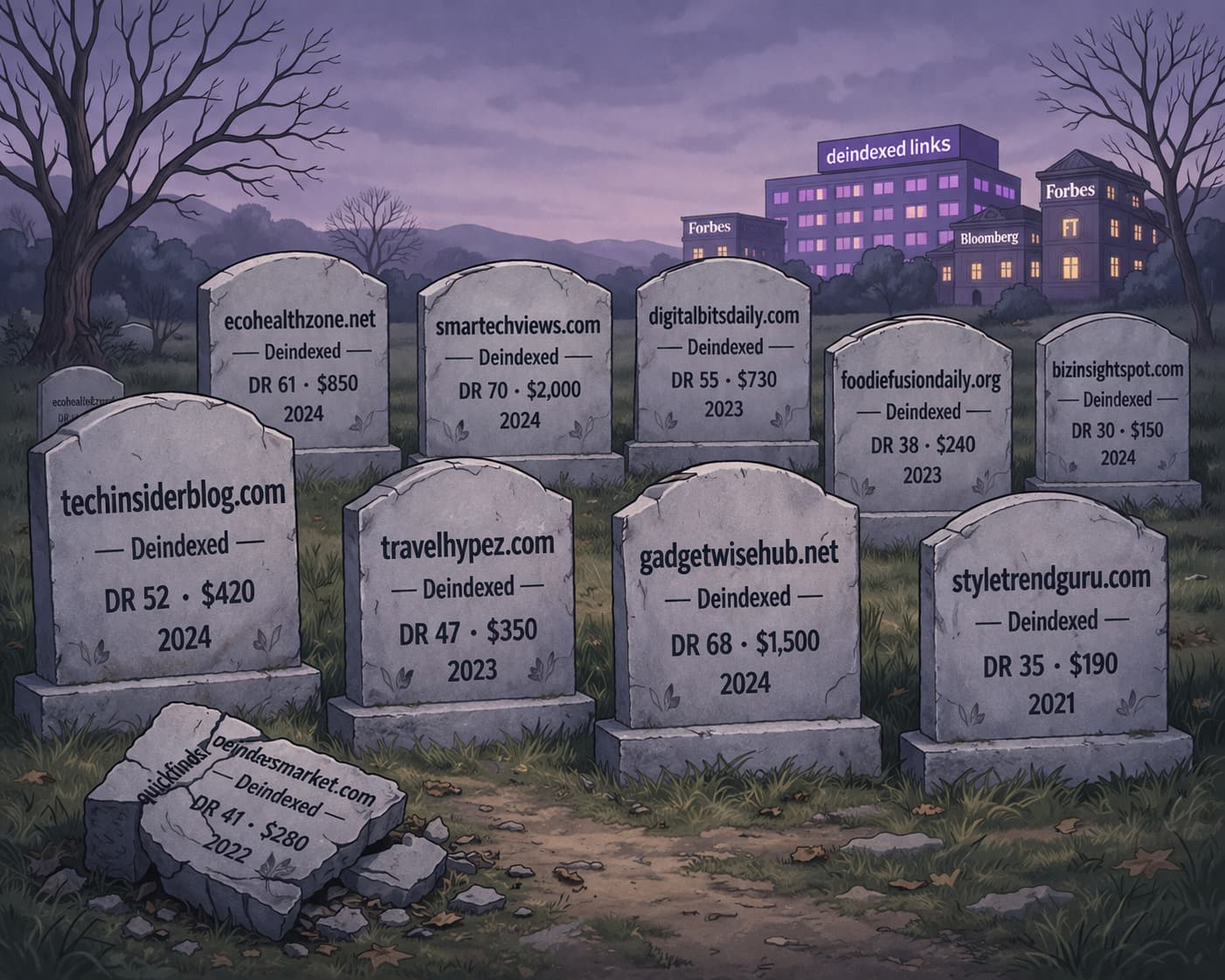
A Deindexed Host Removes Every Link On It From the Google Index
A backlink only counts if the page hosting it is indexed. The moment Google deindexes a domain, every link on it disappears from the link graph. The money spent on those links goes to zero.
Google has been deindexing sites at scale since the 2022 Helpful Content Update, and the core updates that followed have escalated it. The targets are consistent: sites that exist to host third-party content for SEO.
Marketplace guest post sites fit that profile exactly. Many have already been deindexed. Many more are in the queue. When a link host gets deindexed, the buyer does not get a refund. Most marketplaces offer 6 to 12 month guarantees, but a replacement on another marketplace site carries the same risk.
AI answer engines can only cite what their retrieval layer has access to, and every one of those retrieval layers depends on a search index. ChatGPT, Perplexity, Gemini, and Google's AI Overviews all work this way. Deindexed content fails the threshold completely. Paid links on marketplace sites are failing it at scale.
Annualised, Earned Coverage Costs Five Times Less Than Paid Links
Same upfront cost, different useful lifespans. Annualised, the comparison inverts the assumption that earned coverage is more expensive.
Take a $400 to $700 paid link on a DR50 to 60 marketplace site, the tier buyers choose when they want "quality." Useful lifespan: one year, before the site is deindexed, the link drops, or the page gets pruned. That works out to $400 to $700 per useful year.
A placement at the same price on an authority publisher holds for five years, minimum. Established publications do not get deindexed. The coverage stays in the editorial record. That works out to $80 to $140 per useful year. Same upfront cost, five times the useful life.
The same pattern holds at lower price points. A $150 marketplace link lasting one year costs $150 per useful year. A $150 earned placement on a mid-tier trade publication, held for five years, costs $30 per useful year. Earned coverage wins on annualised cost at every tier.
Every price in this report is the cost of a link that used to be durable. A DR50 marketplace placement in 2020 worked. The same link in 2026 is a bet that the site survives the next core update. The framework for which sources AI systems draw from is citation equity: deindexed content fails it completely, and marketplace links are failing it at scale.
Methodology
This report aggregates pricing data from multiple independent marketplace studies and primary-source platform observations.
- BuzzStream (2025): analysis of 26,000+ guest post sites from a major vendor database, with quality tiering by traffic and DR.
- Adsy (2025): pricing analysis across 37,542 publisher websites.
- Serpzilla (2026): live marketplace data from thousands of guest post and niche edit listings.
- Linkhouse (2026): validated against live pricing from 76,861 publisher listings across 25 languages.
- Additional platforms: Collaborator, Getfluence, WhitePress, GuestPostLinks, Bazoom, and LinkPublishers.
- Service providers: published pricing from 10+ named agencies and services.
- Wayback Machine (2020 to 2026): primary-source pricing snapshots across FATJOE, Searcharoo, Loganix, RhinoRank, and The HOTH, extracted via the Internet Archive CDX API. 104 observations, audit trail preserved.
- FatRank industry cost study (2024): cross-network pricing analysis from an investor in multiple link-building platforms, providing publisher-direct vs agency-managed cost comparison.
- Vendor-published review articles (2020 to 2026): dated third-party reviews citing then-current vendor pricing tables, used to corroborate and fill gaps in Wayback coverage.
All prices converted to USD at March 2026 exchange rates. Vendor markup estimates follow BuzzStream's methodology. Quality filtering uses BuzzStream's criteria: minimum 1,000 monthly organic traffic and minimum DR 40.
For the longitudinal dataset, one representative Wayback snapshot per year was selected per vendor (closest to mid-year) and parsed for tier pricing. DR and DA tiers are treated as equivalent since major vendors switched labelling conventions mid-window without changing the underlying product. LinksThatRank was excluded from the longitudinal chart because their pricing is rendered client-side; Wayback captures only the empty shell. The HOTH was excluded because their SKU mix changed substantially across years. Raw dataset available on request.
How to cite this report
Ranking Atlas. "The Hidden Economy Behind Google Rankings." ranking-atlas.com/resources/the-cost-of-authority. Published March 2026. Limitations
Marketplace pricing is opaque by design. Listings shift weekly, off-platform negotiation is common, and vendors discount inconsistently for repeat buyers. The ranges in this report reflect the published mid-band but cannot capture every off-list deal.
Wayback Machine coverage is uneven. Some vendor pages render pricing client-side, which the Internet Archive captures as an empty shell. Other vendors restructured URL paths during the window and broke the snapshot chain. Both effects bias the longitudinal sample toward vendors with stable, server-rendered pricing tables.
Quality thresholds are conventions, not laws. BuzzStream's DR40 + 1,000 monthly visitor filter is reasonable but not authoritative. A tighter threshold would shrink the qualifying share below 4.6%; a looser one would raise it. The directional finding holds at any reasonable cut.
Deindexing rates are not directly observable site-by-site. The conclusion that marketplace sites are disproportionately exposed to deindexing waves draws on Google's own communications about Helpful Content and core update targeting, plus publicly documented cases. It is not a measured deindexing rate.
Useful-lifespan estimates for earned coverage on authority publishers assume the publication itself remains indexed and the URL remains live. Publication closures and content pruning do happen at the top tier, just at a much lower rate than at marketplace tier.
For a different cut of this pricing data, additional vendor or tier breakouts, or methodology questions, contact contact@ranking-atlas.com.
Related Research
Why Earned Links Beat Paid Links
This essay shows why earned editorial coverage compounds across organic search and AI answers, while paid links decay in citation value.
Welcome to the SaaSpocalypse
This data report shows how vibe-codeable SaaS categories lost all pricing power while AI-resistant tools raised entry-tier prices three times faster than inflation.
How Brands Get Cited By AI: The 2026 Guide To Citation Equity
This guide explains how ChatGPT, Perplexity, Gemini, and Google AI Overviews choose which brands to cite, and what produces the editorial pattern that puts you in the answer.
Ranking Atlas is a specialist data campaigns firm. We turn proprietary data, commissioned research, and original analysis into visual stories and interactive studies that earn authoritative coverage.
For methodology questions, additional data cuts, or research enquiries: contact@ranking-atlas.com.