
Digital PR vs link building: what's the difference and which do you need?
Here is the difference on the invoice, on the risk ledger, and on the balance sheet three years later, without the cheerleading that every agency comparison of these two ends in.
What is the difference between digital PR and link building?
Digital PR earns editorial coverage and links through stories journalists choose to publish. Link building acquires placements through outreach or payment you control. For AI visibility, editorial coverage matters more, because AI engines corroborate brands across independent retrieved sources and bought links aimed only at rankings usually do not enter that set. Link building still has legitimate page-level ranking uses; it is a different purchase.
To see how AI engines treat your category today, talk to us.
What is link building in 2026?
Strip the euphemisms and modern link building is three activities.
| Activity | What it involves |
|---|---|
| Outreach placements | Guest posts, niche edits and resource-page links negotiated with site owners, usually with money or content changing hands. |
| Marketplace buying | Links purchased through brokers and platforms at listed prices. |
| Technical reclamation | Fixing broken links, converting unlinked mentions, the genuinely clean residue of the discipline. |
- What it involves:
- Guest posts, niche edits and resource-page links negotiated with site owners, usually with money or content changing hands.
- What it involves:
- Links purchased through brokers and platforms at listed prices.
- What it involves:
- Fixing broken links, converting unlinked mentions, the genuinely clean residue of the discipline.
The economics are transparent because the market is literally priced. We analysed six years of the paid link marketplace across 140,000 publisher listings for our study of the hidden economy behind Google rankings, and the pattern that matters here is simple: prices rose after every Google crackdown, because enforcement removes supply without touching demand. You are not buying an asset in that market. You are renting a signal whose landlord is being actively hunted.
That is the risk column the link-building pitch omits. Google's spam updates have repeatedly devalued purchased and scheme-adjacent links at scale, most recently in the March 2026 round that hit templated, scaled acquisition hardest. Devaluation is the polite outcome: the links you paid for silently stop counting, and the budget evaporates retroactively. The impolite outcome is a manual action. Either way, the defining property of a rented signal is that it can be repossessed, and the repossession happens all at once, on someone else's schedule.
And the honest other side, which digital PR agencies omit in turn: within its limits, link building works. Page-level anchor relevance moves rankings for specific commercial URLs in ways brand coverage does not. It is fast, it scales predictably, and in low-competition niches a modest, sensibly built link profile is often all the authority a site needs. If your problem is one product page stuck on position eight for a winnable term, a research campaign is the wrong prescription and a good outreach operator is the right one.
What is digital PR, and how does it fail?
Digital PR earns coverage by giving journalists something worth writing about, and in its strongest form that something is original data: a study, a dataset, a finding that the article cannot exist without citing. The links arrive as a byproduct of editorial judgement, which is precisely what makes them durable: they were never for sale, so they cannot be repossessed as purchases.
Now the numbers the digital PR industry prefers to keep vague, because they cut both ways. Campaigns fail. A realistic pickup rate for competent data-led pitching runs low single digits of pitches converting to placements, some campaigns outperform wildly and some produce nothing, and anyone quoting you a smooth average return figure is quoting marketing, not measurement.
The economics only work at the portfolio level, across successive campaigns, which is why serious programmes run in waves and measure against a baseline rather than judging any single campaign as a verdict. A single data campaign runs four to six weeks from kickoff, and visibility in search and AI answers compounds across successive campaigns over months as each round of coverage extends the citation base.
Why tolerate that variance? Because of what the successful placements are. A journalist's article citing your research produces, simultaneously: a followed editorial link Google's systems treat as the genuine article because it is one, a brand mention in a trusted publication, and one more retrieved source corroborating your brand when AI engines synthesise an answer in your category.
That last output is the one link building is structurally unable to produce. Engines name brands that appear across multiple independent retrieved sources; a purchased link on a site nobody reads adds nothing to that corroboration, while one piece of national coverage adds to it every time the question is asked. The mechanism is laid out in our guide to citation equity, and the durability argument in earned links versus paid links.
How do digital PR and link building compare?
Scored across seven dimensions, link building wins speed, unit cost, control and page-level ranking impact, while digital PR wins AI visibility and brand asset value. Risk is inverted: link building carries enforcement risk and digital PR carries execution risk. Neither wins everything, so the right choice depends on whether the problem is page-level or authority-level.
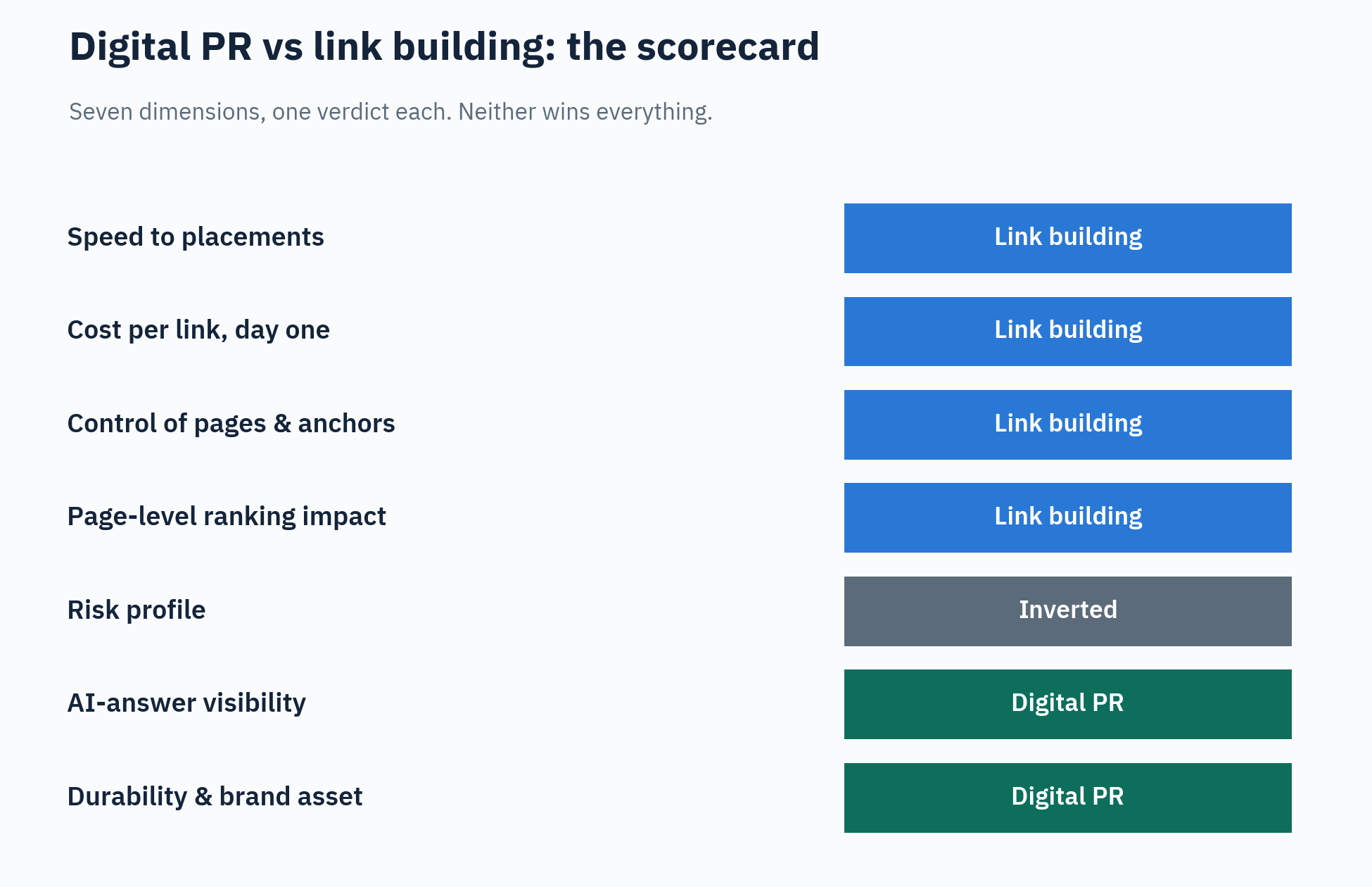
| Dimension | Winner | Why |
|---|---|---|
| Speed | Link building, clearly | Placements in weeks; campaigns in six, with compounding measured in months. |
| Cost per link | Link building on paper | The correction: price the two on cost per surviving, counting link over three years, after devaluations, and the gap narrows dramatically or inverts. Rented signals depreciate; earned ones accrue interest as other writers cite the coverage. |
| Control | Link building | You choose target pages and anchors. Digital PR cannot dictate what a journalist writes, which is the whole point and occasionally the frustration. |
| Page-level ranking impact | Link building, for specific commercial URLs | Digital PR lifts the domain and the entity more than the money page. |
| Risk profile | Inverted between them | Link building carries enforcement risk (the tactic is the violation, and the sanction is retroactive). Digital PR carries execution risk (the campaign can flop, and the sanction is a wasted cycle). |
| AI visibility | Digital PR, and it is not close | Citation in AI answers runs on retrieved, trusted, independent sources. Editorial coverage is that source class. Purchased placements on low-trust domains are not retrieved, not trusted, and add no corroboration. |
| Brand asset value | Digital PR | Coverage is a public, verifiable footprint that works on buyers, investors and journalists doing their next round of research. A backlink profile is invisible to everyone but SEOs. |
- Winner:
- Link building, clearly
- Why:
- Placements in weeks; campaigns in six, with compounding measured in months.
- Winner:
- Link building on paper
- Why:
- The correction: price the two on cost per surviving, counting link over three years, after devaluations, and the gap narrows dramatically or inverts. Rented signals depreciate; earned ones accrue interest as other writers cite the coverage.
- Winner:
- Link building
- Why:
- You choose target pages and anchors. Digital PR cannot dictate what a journalist writes, which is the whole point and occasionally the frustration.
- Winner:
- Link building, for specific commercial URLs
- Why:
- Digital PR lifts the domain and the entity more than the money page.
- Winner:
- Inverted between them
- Why:
- Link building carries enforcement risk (the tactic is the violation, and the sanction is retroactive). Digital PR carries execution risk (the campaign can flop, and the sanction is a wasted cycle).
- Winner:
- Digital PR, and it is not close
- Why:
- Citation in AI answers runs on retrieved, trusted, independent sources. Editorial coverage is that source class. Purchased placements on low-trust domains are not retrieved, not trusted, and add no corroboration.
- Winner:
- Digital PR
- Why:
- Coverage is a public, verifiable footprint that works on buyers, investors and journalists doing their next round of research. A backlink profile is invisible to everyone but SEOs.
Which one does your brand actually need?
A brand needs link building when the problem is page-level: specific URLs, winnable terms and a need for speed. It needs digital PR when the problem is authority-level: which brands search and AI engines cite and name in its category. Where both problems exist, digital PR is the compounding layer and conservative link work handles acute page-level gaps.
Buy link building when: the problem is page-level (specific URLs, winnable terms, thin competition), speed matters more than durability, the budget is small enough that a campaign's variance is unaffordable, and you are disciplined enough to keep acquisition patterns conservative in a post-March-2026 enforcement environment.
Buy digital PR when: the problem is authority-level (the domain, the brand, the category question of who gets cited and who gets named by the engines), you can fund a portfolio of campaigns rather than staking everything on one, and you want the spend to still exist as an asset in three years. Ranking Atlas sells that purchase as Digital PR Campaigns, each built around one research-led story.
The middle path most guides skip: reactive source work through journalist platforms sits between the two, cheap and real but producing the weakest earned citations. We covered that trade-off, platform by platform, in our guide to HARO alternatives.
The sequencing that actually happens at well-run companies: conservative link building to fix acute page-level problems, digital PR as the compounding layer, and measurement across both so budget follows evidence.
On measurement, one test exposes most vendors of either service. A brand can be strong on prompts containing its name and absent from the questions buyers actually ask, and a single blended number hides exactly that gap.
Before signing, run through our seven checks to verify a digital PR agency's results.
FAQ
Is digital PR just link building with better branding?
No, and the difference is mechanical. Link building acquires placements through transactions you control. Digital PR earns coverage through editorial decisions you influence but do not control. The outputs differ in durability, in risk, and in whether AI engines treat them as corroborating sources.
Is link building dead in 2026?
No. Manipulative, scaled, templated link building is dying by enforcement, and the March 2026 updates accelerated that. Conservative, relevant, page-level link work still moves rankings and still has legitimate uses. What died is the idea that a purchased link profile is a durable asset.
Which is better for AI visibility, ChatGPT and AI overviews?
Digital PR, structurally. AI engines synthesise answers from retrieved, trusted sources and name brands corroborated across several of them. Editorial coverage builds that corroboration; purchased links on low-trust domains do not enter the retrieved set at all.
What does each cost?
Link building is priced per placement in an openly listed market, from tens to thousands of pounds per link depending on the host site. Digital PR is priced per campaign or retainer, with a single research-led campaign running four to six weeks from kickoff. Compare them on cost per surviving citation over years, not cost per link on delivery day, and the calculation changes materially.
Are digital PR retainers or pay-per-placement models more cost-effective?
Neither is cheaper by default. Pay-per-placement and link packages buy a known unit at a listed price, which suits page-level link work. Per-campaign and retainer fees buy the research and outreach that earn editorial coverage, whose yield varies by campaign. Compare cost per surviving, relevant citation over years, and ask any vendor for every placement with a live URL.
Can i do both?
Most mature programmes do, sequenced: link work for acute page-level problems, campaigns for compounding authority, one measurement baseline across both so the budget argument settles itself with data.
Want AI to recommend you?
Ready to scope one? Discuss a Digital PR Campaign.