
HARO alternatives 2026: 10 platforms, assessed by a pitch writer.
The platforms that filled the gap, what each is genuinely good for, and the question every other guide avoids: what a reactive quote is actually worth now.
Written by someone who wrote HARO pitches professionally.
What are the best sites like HARO (help a reporter out)?
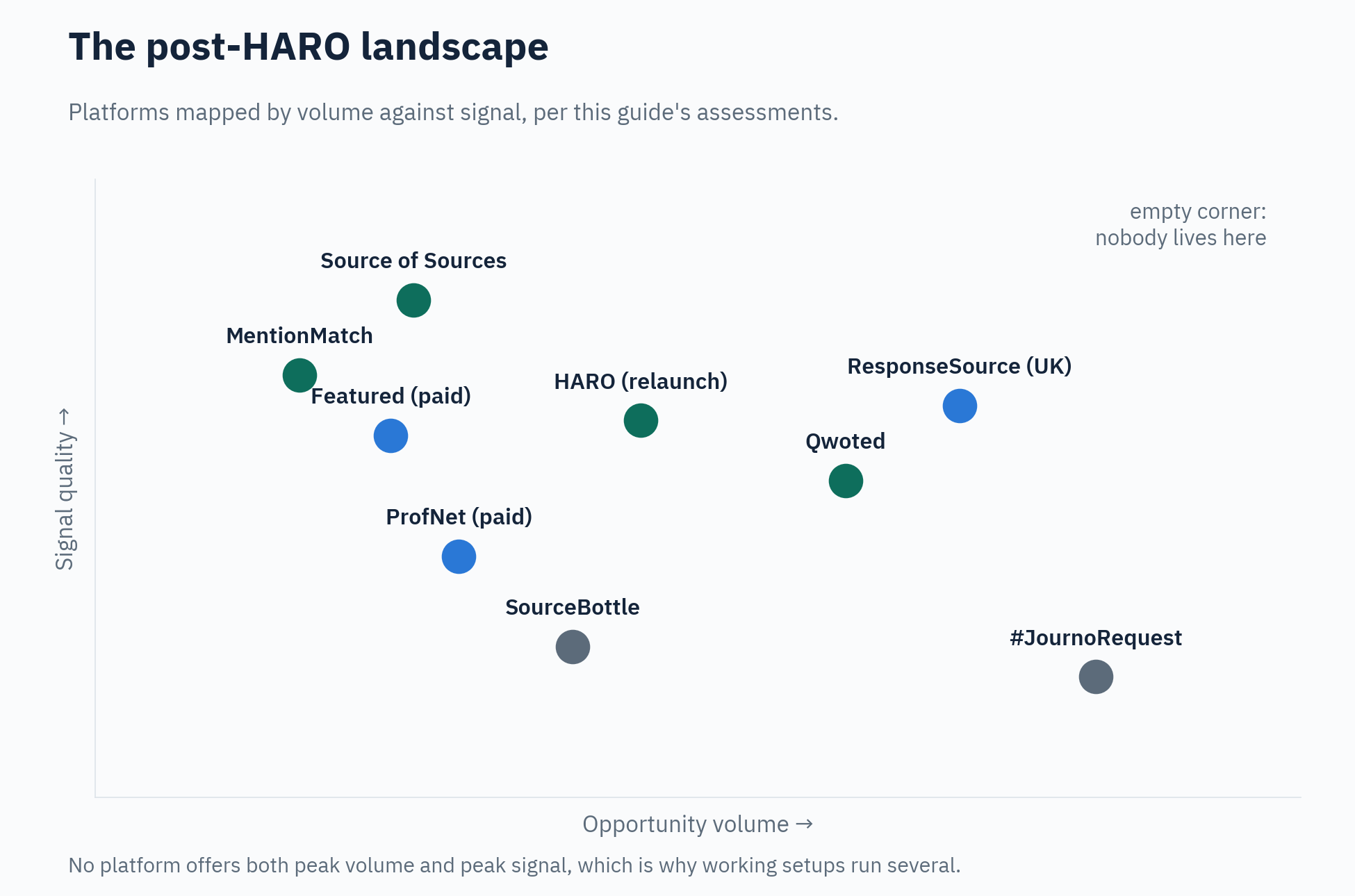
The best sites like HARO (Help a Reporter Out) in 2026 are Source of Sources for signal quality, the relaunched HARO for familiarity, Qwoted for general B2B volume, MentionMatch for B2B SaaS, Featured for vetted opportunities, ResponseSource and JournoLink for UK press, SourceBottle for international coverage, ProfNet for credentialed experts, and #JournoRequest on X for speed.
Source of Sources (SoS) is the spiritual successor, built by HARO's original founder, free, with the best signal-to-noise ratio of the current field. HARO itself is back, relaunched by Featured.com in April 2025 as a free email digest, and it is a different, leaner animal than the original. Qwoted is the strongest general-purpose platform, particularly for finance, tech and B2B.
MentionMatch (formerly Help a B2B Writer) is the pick for B2B SaaS specifically. ResponseSource and JournoLink serve UK media properly, which almost no US-written guide mentions. And #JournoRequest on X remains the fastest free channel if you can monitor it.
That is the map. The rest of this guide covers what each platform is actually like to use, and then the part that matters more than platform choice: whether reactive quote-hunting deserves the hours it consumes.
| Platform | Cost | Region | Best for | Volume | Signal quality |
|---|---|---|---|---|---|
| Source of Sources | Free | US | Quality core of a multi-platform routine | Low | High |
| HARO (Featured.com) | Free | US | Familiar format with strict spam controls | Low | Medium |
| Qwoted | Freemium | US | Finance, fintech and B2B tech | Medium | Medium |
| Featured | Freemium | US | Fewer, better opportunities with vetting | Low | High |
| MentionMatch | Free | US | B2B SaaS specifically | Low | High |
| SourceBottle | Free | AU / International | Coverage beyond US-UK, podcast opportunities | Low | Medium |
| ProfNet | Paid | US | Academics, healthcare, corporate SMEs | Medium | Medium |
| ResponseSource | Paid | UK | UK national and trade press volume | High | Medium |
| JournoLink | Paid | UK | Smaller UK businesses with bundled PR tools | Medium | Medium |
| #JournoRequest on X | Free | US / UK | Speed; fastest relevant reply wins | High | Low |
- Cost:
- Free
- Region:
- US
- Best for:
- Quality core of a multi-platform routine
- Volume:
- Low
- Signal quality:
- High
- Cost:
- Free
- Region:
- US
- Best for:
- Familiar format with strict spam controls
- Volume:
- Low
- Signal quality:
- Medium
- Cost:
- Freemium
- Region:
- US
- Best for:
- Finance, fintech and B2B tech
- Volume:
- Medium
- Signal quality:
- Medium
- Cost:
- Freemium
- Region:
- US
- Best for:
- Fewer, better opportunities with vetting
- Volume:
- Low
- Signal quality:
- High
- Cost:
- Free
- Region:
- US
- Best for:
- B2B SaaS specifically
- Volume:
- Low
- Signal quality:
- High
- Cost:
- Free
- Region:
- AU / International
- Best for:
- Coverage beyond US-UK, podcast opportunities
- Volume:
- Low
- Signal quality:
- Medium
- Cost:
- Paid
- Region:
- US
- Best for:
- Academics, healthcare, corporate SMEs
- Volume:
- Medium
- Signal quality:
- Medium
- Cost:
- Paid
- Region:
- UK
- Best for:
- UK national and trade press volume
- Volume:
- High
- Signal quality:
- Medium
- Cost:
- Paid
- Region:
- UK
- Best for:
- Smaller UK businesses with bundled PR tools
- Volume:
- Medium
- Signal quality:
- Medium
- Cost:
- Free
- Region:
- US / UK
- Best for:
- Speed; fastest relevant reply wins
- Volume:
- High
- Signal quality:
- Low
Assessments as of September 2026. Verify current pricing on each platform.
What happened to HARO and connectively?
HARO (Help a Reporter Out) was rebranded as Connectively by Cision in early 2024 and shut down on 9 December 2024. Featured.com bought the HARO brand and relaunched it as a free email digest in April 2025. Peter Shankman, who founded HARO, now runs Source of Sources, a competing free service.
Most guides muddle the timeline, so here it is precisely.
-
Founded, then sold
Peter Shankman founded Help a Reporter Out and later sold it; it ended up inside Cision.
-
Early 2024: Rebranded as connectively
Cision rebranded HARO as Connectively and moved it toward a pay-to-pitch model, which the community loathed.
-
9 December 2024: shut down
Cision shut Connectively down entirely as part of its pivot to CisionOne.
-
April 2025: Relaunched by featured.com
Featured.com bought the HARO brand from Cision and relaunched it as a free email digest, with subscriber emails resuming on 22 April 2025.
Meanwhile Shankman, watching the implosion, had already built Source of Sources as the community's replacement.
So in 2026 you have an odd landscape: the original brand is alive under new ownership, the original founder runs a competing free service, and a generation of venture-backed platforms grew up in the vacuum. Here is what each is for.
What is each HARO alternative good for?
Each HARO alternative suits a different job: Source of Sources and MentionMatch trade volume for signal quality, Qwoted and ResponseSource bring more journalist requests, Featured and ProfNet are effectively paid channels for vetted or credentialed experts, and #JournoRequest on X rewards whoever replies fastest. Most working routines combine several.
Source of sources (SoS)
Shankman's rebuild of his own idea: an email digest of journalist requests, free for everyone, run on an honour system with a one-strike ban for off-topic pitching. The signal-to-noise ratio is the best in the field precisely because of that policy, and the journalist quality is high because the original HARO network followed its founder. The trade-off is volume: fewer queries than the aggregator platforms, so it cannot be your only channel. Treat it as the quality core of a multi-platform routine.
HARO (the featured.com relaunch)
Back from the dead as a free email-based service, closer to the original model than Connectively ever was, with a notable upgrade: aggressive spam controls including AI content detection, LinkedIn profile verification and screening for fake headshots, with lifetime bans for violators. Those controls exist because the platform's biggest threat is the flood of AI-generated pitches that made the late HARO era nearly unusable. It is leaner than the original at its peak, and that is mostly an improvement. Worth being on; not worth depending on.
Qwoted
The strongest general-purpose platform, with profile-based matching so journalists can find you proactively, a workable free tier, and particular strength in finance, fintech and B2B tech. The premium tier buys priority and more categories. The honest limitation is inconsistency: it might surface three relevant queries one day and none for the rest of the week, which is a property of the whole post-HARO landscape rather than a Qwoted defect.
Featured
A curated marketplace connecting vetted experts with publishers, with a transparent pipeline showing each answer's status from review to publication. The vetting is the value: less noise, higher acceptance quality. The free plan is capped at a handful of answers a month, which is not enough to matter, so this is effectively a paid channel. Best for operators who want fewer, better opportunities and will pay to skip the scrum.
MentionMatch (formerly help a B2B2B writer)
B2B only, which is exactly why it works if that is your world. Queries are narrower and better matched, competition per query is lower, and the writers are producing the kind of B2B content where an expert quote genuinely fits. Volume is modest. If you sell SaaS, this plus SoS covers a surprising share of the useful opportunities.
SourceBottle
The international option, Australian in origin, with a loyal journalist base outside the US and podcast opportunities most platforms lack. The interface shows its age. Useful for brands wanting coverage beyond the US-UK axis. sourcebottle.com
ProfNet
Cision's surviving source platform: paid, institutional, strongest for academics, healthcare and corporate subject-matter experts. If your experts have credentials rather than opinions, it earns its fee; for scrappy founder-led pitching it is the wrong shape. profnet.prnewswire.com
ResponseSource and JournoLink (UK)
The gap in every American guide. ResponseSource is the established UK journalist enquiry service, long used by UK PR teams, with real volume from national and trade press. JournoLink suits smaller UK businesses with bundled PR tooling. If your buyers and press are British, these two plus #JournoRequest will outperform the entire US platform stack.
#JournoRequest and #PRRequest on x
No platform, no fee, no digest delay: journalists post requests directly and the fastest relevant reply often wins. The speed advantage is real and so is the monitoring burden. Set alerts or accept that you will miss most of it. Best used as a supplement that occasionally lands the placement none of the platforms surfaced.
Diptell
The paid alternative to pitching: a fixed-price, done-for-you press release service. Diptell writes the release and syndicates it to outlets including Yahoo Finance, USA Today and AP News, plus 400+ other sites, for a one-time fee of $888. It is usually live within three to four days, with a refund if it isn't published. Useful when you need named-outlet placements on a deadline rather than waiting for the right query.
What gets a HARO pitch read?
A HARO pitch gets read when it arrives among the first handful of replies, restates the journalist's angle in the subject line with one specific number, gives the answer in the first sentence, and stays quotable in two to four sentences. Writing these professionally taught me that platform choice matters less than those four things.
-
Speed
The first handful of replies get read; the rest mostly don't. If you can't respond within the hour, skip the query rather than send a late pitch that trains the journalist to ignore your name.
-
Subject line does the work
Restate their angle back to them with one specific number or claim from your answer. "Re: Remote work security: 62% of breaches start with a personal device" gets opened. "Expert source available" doesn't.
-
Answer in the first sentence
Credentials come after, in one line. Journalists skim from the top and stop when they have a usable quote. Give them the quote first, then tell them who said it.
-
Be quotable, not comprehensive
Two to four sentences they can lift verbatim beat five paragraphs they have to edit. If your answer needs a chart, it's a study, not a pitch.
The filters that now police these platforms are hunting for generic, AI-shaped answers. A specific number, a real example, and a stated opinion are what get through, and they are also what get quoted.
What do HARO alternatives guides leave out?
HARO alternatives guides leave out two things. The economics of source platforms got permanently worse after 2024, with fewer journalist requests and far more pitches per query. And a reactive quote is the weakest citation asset a brand can earn: coverage built around your own research compounds, while an incidental quote mostly does not.
Here is the section the platform vendors and the agencies selling pitch services will not write, from someone who has written HARO pitches professionally.
The economics got worse, permanently. Journalist request volume across the source-platform ecosystem has fallen sharply since 2024, with credible estimates putting the decline at half or more, while the number of people pitching kept rising and generative AI cut the cost of a pitch to nearly zero. Every platform is now running an arms race between AI-written pitches and AI-powered spam filters.
The practical consequence: response competition per query is brutal, speed decides outcomes (the first handful of pitches in an inbox get read, late ones rarely do), and maintaining real output means checking four or five platforms several times a day. That is a part-time job. Price it like one.
If you would rather not run that part-time routine by hand, MentionAgent automates the search for relevant blogs and the outreach itself, and its guide to the best link building tools in 2026 compares the options side by side.
A reactive quote is the weakest citation asset you can earn. This is the structural point, and it matters more than platform selection. When a journalist quotes you in their story, you get a name-check in coverage built around someone else's narrative, frequently unlinked, and interchangeable with the other expert they nearly used instead.
It has value: real publications, real mentions, and in aggregate a legitimate authority signal, including to the AI engines that increasingly weight editorial brand mentions when deciding who to cite. But it is the bottom of the asset class.
The coverage that compounds is the story built around you: your data, your research, your finding, where the article cannot exist without citing you, the link is structural rather than courteous, and every subsequent writer on the topic inherits the citation. We have written up the mechanics of why earned citations compound while rented and incidental ones decay, and how that compounding now decides visibility in AI answers as well as search.
When are source platforms like HARO worth your time?
Source platforms like HARO fit when three things are true: someone in the company has genuine expertise a journalist would want (not a marketing manager relaying talking points), that person's time is cheap enough to spend on a low-hit-rate activity, and your expectations are calibrated to reality, which in 2026 means treating a small single-digit percentage of pitches converting to mentions as a good run, with output arriving irregularly.
They are the wrong tool when you need predictable link volume on a deadline, when the pitching would be outsourced to someone without the expertise (the AI-slop filters are now specifically hunting that), or when the same hours could produce an asset. A founder spending five hours a week on source platforms for a year will accumulate a scattering of mentions. The same hours pointed at one original dataset can produce the study that earns the coverage, and keeps earning it.
We are biased on this point, because building those studies is our work, sold as Digital PR Campaigns, so do not take our word for it: track your own hours against your own placements for a quarter and let the numbers decide. If the answer is an agency, our guide to how to verify a digital PR agency's results covers the due diligence.
FAQ
Is HARO still active in 2026?
Yes, but read the history. The original HARO became Connectively under Cision and was shut down on 9 December 2024. Featured.com acquired the brand and relaunched it in April 2025 as a free email digest with strict anti-spam controls. It works, and it is a smaller, stricter service than the one you remember.
What is the best free HARO alternative?
Source of Sources for quality, the relaunched HARO for familiarity, Qwoted's free tier for volume, and #JournoRequest on X for speed. Most working practitioners run several at once because no single platform has the volume to stand alone.
What response rate should i expect?
Low single digits from pitch to published mention is a realistic planning number for competent, fast, genuinely expert pitching, with meaningful variance by niche and by how quickly you respond. Anyone promising a reliable high hit rate from source platforms in 2026 is selling something.
Do HARO-style links still help SEO and AI visibility?
Yes, with the asset-class caveat above. Editorial mentions in real publications remain a trust signal for search and are increasingly weighted by AI engines deciding which brands to cite. A portfolio of incidental quotes is a modest, legitimate contribution to that. Coverage of your own research is a far larger one, because the citation is structural and repeats. The mechanism is covered in our guide to citation equity.
Which platform is best for UK coverage?
ResponseSource for volume and national press reach, JournoLink for smaller businesses, plus #JournoRequest, where UK journalists are especially active. The US platforms skew heavily toward American outlets.
Want AI to recommend you?
Ready to scope one? Discuss a Digital PR Campaign.